Bracket creep: The slow creep that’s been picking your pocket
Bracket creep: The slow creep that’s been picking your pocket
By Beatrie Gouws
Measuring inflation, means measuring the rate at which prices rise: For example, where a litre of milk or a loaf of bread costs more today, than it used to.
Annual inflationary adjustments to tax brackets aims to address the effect of fiscal drag on taxpayers.
Fiscal drag (aka bracket creep) happens when inflation pushes nominal incomes higher, but where the tax brackets stay the same thereby causing taxpayers to be taxed more, even though their real (inflation-adjusted) income has not increased.
Stated differently, if your salary increases annually to keep up with the growing cost of living, you will annually be taxed at higher marginal tax rates.
The last South African budget that gave meaningful fiscal drag relief appears to have been the 2023/24 budget. Subsequent budgets (2024 - 2026) did not adjust tax thresholds and rebates fully for inflation, thereby effectively letting bracket creep generate revenue instead.
It should be mentioned that the initial 2026 Budget included proposed adjustments to the personal income tax brackets and rebates that would have reduced pressure on lower-income earners and provided partial relief for higher income earners. However, this proposal was part of the casualties when the proposed VAT increases were denied.
For 2027, we are buoyed by the proposed adjusting of personal income tax brackets and rebates fully in line with inflation. It is especially welcome that relief is also reaching the lower 18% bracket.
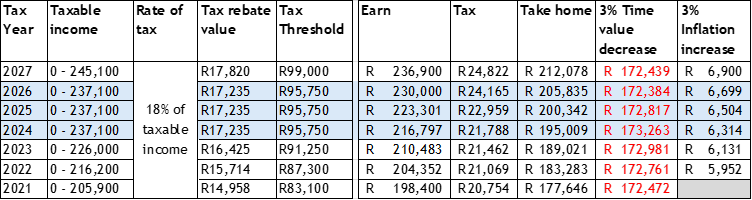
Fiscal drag aside, if increases in income do not keep track annually with your personal rate of inflation, you will find yourself running short.
Where the Consumer Price Index (CPI) averages costs, your personal inflation rate tracks inflation for items you consume, such as higher education or specific lifestyle expenses.
To accurately measure your personal inflation, you should compare your total spending in a specific period (e.g., this month) against the same period from a year ago. You can specifically focus on three concrete items:
- New monthly expenses: New expenses may be due to new needs, e.g. education for children, or because a more cost-effective option fell away, e.g. busses are no longer available, and you now take a taxi to work.
- Lifestyle improvements: A quick example here is if where you start buying more expensive groceries or opt to take up a new hobby.
- One-off large purchases: If you purchase a vehicle or a house, you should consider how the related costs will impact your expenses.
Prior to getting to making use of the Government’s social safety net, there are still a lot of services and infrastructure that taxpayers rely on. Therefore, especially at the lower end of the brackets, a taxpayer’s personal inflation rate is heavily impacted by their access to Government services and infrastructure.
That is why we are so encouraged by the Finance Minister’s proposals on improving public spending, as well as spatial and housing reforms focussing on restructuring of our cities to ensure that people have access to affordable housing located close to centres of economic activity.